The Legendary Elsie de Wolfe: Fact and Fiction by Design
Jared Goss, Metropolitan Museum of Art
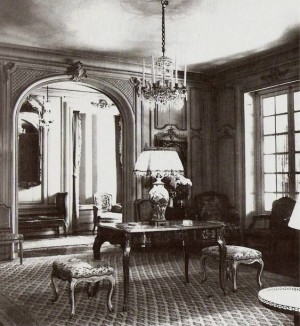
Interior of Elsie de Wolfe’s Villa Trianon, her home in Versailles, France

Portrait of Elsie de Wolfe
Almost more than any other figure in her field, the decorator Elsie de Wolfe (1865–1950) seems to elicit an endless amount of breathless admiration. Open any book devoted to her - there are many - and certain tropes consistently recur: she was legendary, iconic, revolutionary, the first to have (fill in the blank). Since 1938, when The New Yorker’s Janet Flanner credited Elsie de Wolfe with singlehandedly “inventing the new fashionable profession of interior decorating, countless other such lofty claims have been made and repeated: she “revolutionized twentieth-century design”; she was decorating’s “most famous and successful practitioner”; she was “a dauntless pioneer” who continues to enjoy an “enduring influence” today. Is any of this really true? Jared Goss will examine the facts and fictions of de Wolfe and her work in an attempt to recognize the true and lasting contributions of this extraordinary woman.
Without a doubt, de Wolfe (who had worked as a stage actress) was one of the first well-known female practitioners of interior design. She must be counted among a small number of early 20th century decorators with a taste for antiques rather than made-to-order modern furnishings. Elsie de Wolfe was certainly among the earliest decorators to encourage personality and humor in the interior. Above all, she was without question an interior decorator of taste, originality and accomplishment. Despite her stellar attributes, her list of projects is not especially long and, by her own admission, her home in France represented the best of her work. “If I have done anything really fine, it is the Villa Trianon.”
Following her 1926 marriage to a British diplomat, she became Lady Mendl. Janet Flanner archly observed that “Lady Mendl has always been well known for something - principally for being Miss Elsie de Wolfe.” Perhaps the most interesting aspect of de Wolfe - considered by many to be one of the most influential women of the 20th century - was her talent for self-mythologizing.
She is arguably best remembered today more for her carefully constructed, outsize and flamboyant personality than for any of her specific decorating projects. Elsie de Wolfe was acutely aware of the power of publicity. Her lavish entertaining and eccentric personal habits were as widely chronicled as any of her interiors. She was a central figure of the social circle known as Cafe Society. Even more importantly, she tenaciously and visibly established herself as the tastemaker to Cafe Society. Long before Martha Stewart, Elsie de Wolfe offered professional advice as much on the arts of living as on the design of houses - and usually for a price.
Jared Goss’ wide-ranging education began with a bachelor’s degree in architectural history from the University of Virginia. The Cooper-Hewitt Museum/Parsons School of Design awarded him with a master’s degree in the history of decorative arts. He served as a curatorial assistant in the department of European decorative arts and sculpture at his hometown Fine Arts Museums of San Francisco. Mr. Goss then began a 20-year career as an associate curator specializing in post-1900 design and architecture at the Metropolitan Museum of Art. Among the numerous exhibitions he helped organize are: *Charles Rennie Mackintosh *(1996); *Cartier: 1900–1939 *(1997); *American Modern, 1925–1940: Design for a New Age *(2000) and curated *Ruhlmann: Genius of Art Deco *(2004) and *Barcelona: Gaudi to Dali *(2007). In 2007, Jared Goss completed installation of the Met’s “Wisteria” dining room (designed circa 1910 by Lucien Levy-Dhurmer), the only complete French art nouveau period room with all its original furnishings in an American museum.
His 2009 exhibition, Masterpieces of French Art Deco, inspired him to catalogue the Met’s French Art Deco holdings, not surprisingly published as *French Art Deco *(2014). Jared Goss is now an independent art historian. He last spoke to the Forum about “From Empress Eugenie to the Prince of Chintz: a Short History of Furnishing with Antiques” in 2008.