The Jazz Age: American Style in the 1920s
Stephen Harrison, Cleveland Museum of Art

Muse with Violin Screen (detail), 1930. Paul Fehér (Hungarian, 1898–1990), designer. Rose Iron Works (American, Cleveland, est. 1904), maker. Wrought iron, brass; silver and gold plating; 156.2 x 156.2 cm. The Cleveland Museum of Art, On Loan from Rose Iron Works Collections, LLC, 352.1996. © Rose Iron Works Collections, LLC

Clock, 1928. Jean Goulden (French, 1878–1946). Silvered bronze, colored champlevé enamel; 36.2 x 25.4 x 12.7 cm. Stephen E. Kelly / Kelly Gallery, New York. Photo: Josh Gaddy. © 2016 Artists Rights Society (ARS), New York / ADAGP, Paris

Dressing Table and Bench, c. 1929. After Léon Jallot (French, 1874–1967). Lord & Taylor (American, New York, est. 1826), retailer. Lacquered joined wood, mirror glass, metal; table: 79.3 x 105.4 x 60.3 cm; bench: 49.5 x 54.8 x 31.5 cm. Cooper Hewitt, Smithsonian Design Museum, Gift of James M. Osborn, 1969-97-7a/i.
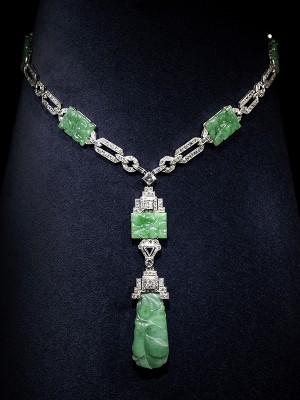
Necklace, c. 1920s. Unknown maker (American). Diamonds, platinum, carved jade; chain: l. 46 cm; pendant: 9.5 x 1.1 x 0.6 cm. Neil Lane Collection. Photo: Gary Kirchenbauer

Brooch, 1929. Raymond C. Yard (American, New York, est. 1922). Diamonds, emeralds, ruby, platinum, onyx; 4.5 x 1.9 x 0.6 cm. Vartanian & Sons. Photo: Matt Flynn
The decade of the 1920s was a glorious age for design. Emerging from the smoke and devastation of the First World War, the mood was one of rebirth and reinvention. From the old order came the new, driven by innovation and the audacity of youth. New fortunes, primarily American ones, fueled a demand for self-indulgence and conspicuous consumption. Both in Europe and the United States, these impulses prompted an explosion of design featuring vibrant new colors, sumptuous materials, and a sense of freedom unlike any other age.
While many now refer to this era by its later 1960s nickname—Art Deco, it was F. Scott Fitzgerald, author of The Great Gatsby, who termed it “the Jazz Age.” An apt metaphor for all artistic expression during this period, jazz reflected a push for modern ideas within the confines of the traditional social order. The music in theaters, dance halls and speakeasies reflected the pulse and rhythm of urban nightlife.
Based on the critically acclaimed catalogue and exhibition The Jazz Age: American Style in the 1920s, Stephen Harrison’s lavishly illustrated talk will explore American taste during the exhilarating 1920s and early 1930s. In these years the United States became the leading marketplace for innovative architecture, interior decoration, decorative arts, fashion, and music. With the map of Europe redrawn and social norms redefined, influences merged, from Paris to Vienna as well as across the United States. American designers led the way in moving industrial design into the domestic and public spheres, while talent, craftsmanship, urbanity and experimentation flowed back and forth across the Atlantic creating an age of glamour unlike any other. Through a rich array of extraordinary works in jewelry, fashion, and decorative arts, featuring the people and events that punctuated the era, Mr. Harrison will present the dazzling world of flappers and dandies in all its dizzying glory.
Mr. Harrison serves as the Curator of Decorative Art and Design at the Cleveland Museum of Art. Prior to joining the CMA in 2005, he held curatorial positions in New Orleans, Dallas, and Atlanta. He earned an MS in historic preservation from the University of Pennsylvania and an MA in early American material culture from the Winterthur Museum Program of the University of Delaware. He has written many articles and publications including the award-winning catalogues, Artistic Luxury: Fabergé, Tiffany, Lalique and The Jazz Age: American Style in the 1920s, an exhibition recently on view at the Cooper Hewitt, Smithsonian Design Museum in New York and the Cleveland Museum of Art. He is a graduate of the University of Virginia, where he was a Jefferson Scholar.