The Art of Scenery: A Tale of the Picturesque Garden in America
John Tschirch, Architectural Historian

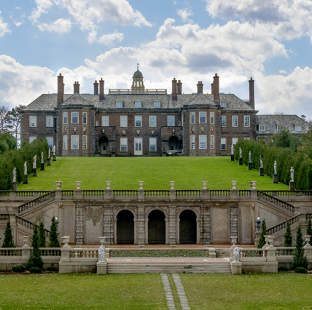
Hammersmith Farm. Newport, RI. Hand-colored Photograph. Circa 1920. Frances Benjamin Johnston. Library of Congress
The pastoral beauty of verdant lawn, meadow and lofty trees as an idealized version of nature is at the very heart of the picturesque, which inspired landscape design in the Old World and New from the 18th century onward. Developed first in Britain by the capable hands of Lancelot “Capability” Brown, the English garden embraced the S shaped path, known as the “line of beauty,” the irregular layout of plantings and long vistas through stretches of grass unencumbered by the formal gardens, rigidly planned flower beds and precisely clipped trees of previous centuries. This natural style of landscape took Europe by storm and made its way to Colonial America, where it would find a population ready and able to capitalize on the picturesque in the crafting of a unique cultural identity in a nation where land was aplenty.
George Washington and Thomas Jefferson redesigned their landscapes in the prevailing taste for the picturesque. The American nurseryman and best-selling writer, Andrew Jackson Downing, popularized the pursuit of the natural in the new garden suburbs of the Victorian era. In a country defined by its open spaces, Frederick Law Olmsted became the father of modern landscape architecture, a proponent of the picturesque in public parks and private estates in numerous landmark designs such as New York’s Central Park, the system of green belts in Boston known as the Emerald Necklace, Biltmore House in North Carolina, the Hammersmith Farm in Newport, Rhode Island, and Stanford University in California.
Celebrated in art, poetry and prose, the picturesque extolled the virtue of the “genius of place.” This illustrated lecture will explore an extraordinary series of places, from parks to private gardens, demonstrating the key features of the picturesque landscape by its greatest masters.
John R. Tschirch is an award winning architectural historian and honorary member of the Garden Club of America. He is presently The Newport Arboretum’s Project Director for “America’s Eden: Newport Landscapes through the Ages,” a multi-year research and publication project documenting all of the art forms that make up the nationally significant cultural landscape of Newport, RI. John is also an instructor for Rhode Island School of Design CE where he is teaching a course entitled, American Eden: Gardens, Forest and Parks. In his role as Director of Museum Affairs and Architectural Historian, from 1986 to 2013, for the Preservation Society of Newport County, in Newport, RI, John served as advisor for historic landscapes maintained at the organization’s eleven house museums. He has been the recipient of research grants from the National Endowment for the Humanities, the National Endowment for the Arts and the Rhode Island Council for the Humanities. Among his publications on landscape, architecture and urban planning are “The Breakers in Newport, RI: The Evolution of a Beaux Arts Landscape” *in the Journal of the New England Garden History (1999) and *“The New Thing atNewport: Kingscote in Newport, RI” in the Magazine Antiques (January 2013). His work has also been featured in The New York Times, Conde Nast Traveler and Martha Stewart Living. Visit www.johnstories.com to learn more.