'Solid and Permanent Grandeur:' The Design Roots of American Classical Furniture
Carley Berlin, Carswell Rush Berlin, Inc
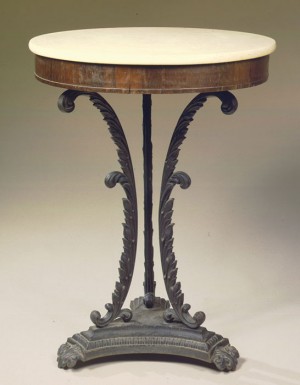
Cast-iron and rosewood marble-top gueridon, attributed to Duncan Phyfe & Sons (active 1837-1847), New York, ca. 1840, inscribed “Phife & Sons” on the underside of the marble
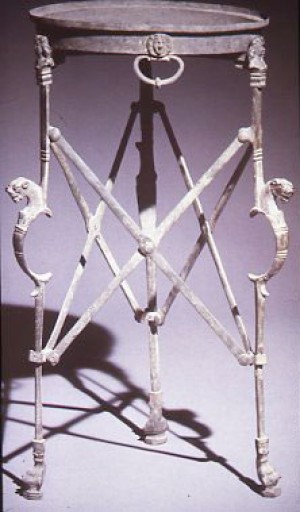
Roman bronze folding tripod and bowl, probably southern Italy, 1000 B.C-100 A.D., British Museum
Are you feeling the need for a refresher course, or even an introduction, to American classical furniture? Carswell Rush Berlin will provide us with a comprehensive primer, focusing on the ancient roots of classical design. Eighteenth-century archaeologists, scholars and artists transmitted the design elements of ancient Rome and Greece to a generation of furniture designers whose publications influenced cabinetmakers throughout the western world.
In 1754, Thomas Chippendale (1718-1779) published the first of many editions of The Gentleman & Cabinet-Maker’s Director, which included detailed plates of classical designs. Lord William Hamilton (1731-1803), England’s envoy to Naples, was also an early archaeologist and omnivorous collector. He published the influential four volumes of the *Collection of Etruscan, Greek, and Roman antiquities from the cabinet of the Honble. Wm. Hamilton, His Brittanick Majesty’s envoy extraordinary at the Court of Naples *(1766-1767, 1769-1776). Lord Hamilton also sold a sophisticated Roman glass vase to the Duchess of Portland, whose loan of the vase to Josiah Wedgwood resulted in popularization of the Portland vase in jasperware. Mr. Berlin will link American classical furniture to precepts that date from antiquity, more than 2,500 years ago, and to furniture that gained popularity in 18th century Europe.
Mr. Berlin will explain how the same classical designs were interpreted in different American cities. As classical furniture design evolved over time, different cities emphasized different design elements. Of course, in the new United States that had symbolically modeled its government and architecture on models from the ancient world, classical design elements were laden with symbolism from the intersection of fashion and political philosophy.
Carswell Rush Berlin earned a bachelor’s degree from Kenyon College. Since then, Mr. Berlin’s eponymous business has become a distinguished purveyor of American formal furniture of the classical period, 1800-1840. His publications include “An Important Rosewood and Cast-Iron Gueridon Attributed to Duncan Phyfe and Sons” in The Magazine Antiques (May 2000); “Classical Furniture in Federal Philadelphia” in Antiques & Fine Art Magazine (Spring 2007); and “ ‘A Shadow of a Magnitude’: The Furniture of Thomas Cook and Richard Parkin” in Chipstone’s American Furniture (2013).