Inventing American Still Life
Mark Mitchell, Philadelphia Museum of Art

Still Life with Peach Blossoms, 1877, by Charles Caryl Coleman (1840–1928), oil on canvas, private collection
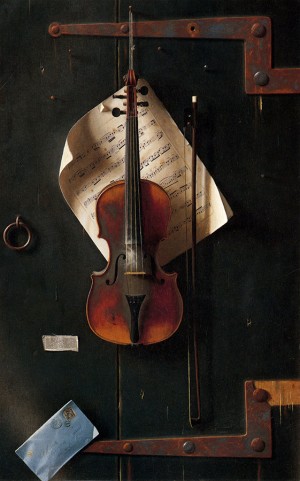
The Old Violin, 1886, by William Michael Harnett (1848–1892), oil on canvas, National Gallery of Art
Dr. Mark Mitchell will offer a preview of Audubon to Warhol: The Art of American Still Life, a searching examination with fresh eyes that American still life has not received in three decades. The Philadelphia Museum of Art’s major survey exhibition (October 27, 2015 to January 10, 2016) will bring together old and new favorites from collections from across the country — including several highlights from the de Young’s collection.
The history of American still lifes has been episodic, waxing in popularity as four different, distinct phases in American art history, only to ebb again decades later as enthusiasm for still life diminished. Mark Mitchell will concentrate on the genre’s primary areas in America; each phase is characterized by a shared visual approach to objects — discerning, describing, animating and indulging the nation’s changing character.
Dr. Mitchell’s talk will highlight the different roles that decorative arts played in American still life. These finely crafted objects, as counterpoints to nature, offered painters a lexicon of aesthetic and cultural meanings to depict. Still life painters, such as Raphaelle Peale, offered the demure simplicity of ceramics used in the Federal period. Nineteenth-century still lifes offered lustrous mahogany carving and marble tabletops that manifested the painters’ values. In the late 19th century, still lifes’ exotic eclecticism echoed Aesthetic Movement interiors and the collections that exuberantly filled those rooms. During the early 20th century, American still life painters increasingly directed their energies toward streamlined industrial designs that were driven by mechanical as well as psychological forces.
The University of Massachusetts prepared Mark Mitchell well for his curatorial position with undergraduate concentrations in art history and languages, French, Italian and German. During his graduate years at Princeton, leading to his doctorate, he was an intern at the Metropolitan Museum of Art and a curatorial assistant at the Princeton University Art Museum. His dissertation, “The Artist-Makers: Professional Art Training in New York City during the Mid-Nineteenth Century,” enriched the knowledge that he brought to subsequent curatorial positions at the Hood Museum of Art, at Dartmouth College; the National Academy Museum in New York; and the Philadelphia Museum of Art, where he is currently Associate Curator of American Art.
Dr. Mitchell’s exhibition catalogues include Francis Augustus Silva (1835–1886), In His Own Light (2002); Self-Expressions: The Drawings of Harvey Breverman (2005); The St. Johnsbury Athenaeum, Handbook of the Art Collection (2006); and George Inness in Italy (2011). He co-authored Luminist Horizons: The Art and Collection of James A. Suydam (2006), and his contributions to The Magazine Antiques are “Reflections: Charles Demuth and Georgia O’Keefe” (2008) and “Rose Fever: The Paintings of George Cochran Lambdin” (2011). July’s speaker also contributed the lead essay to The Mystery of Otis Kaye, Master of Trompe l’Oeil (2015), and he is the lead author of the forthcoming Audubon to Warhol: The Art of American Still Life, the source of his topic for the Forum.