Gorham Silver: Designing Brilliance 1850–1970
Elizabeth Williams, Rhode Island School of Design
This lecture is given in memory of Michael Weller and is sponsored by the Michael Weller Memorial Fund.

Thomas Pairpoint, designer American, 1838-1902 Gorham Manufacturing Company, manufacturer Cellini Vase, 1875 Silver with gilding The Gorham Collection

Gorham Manufacturing Company Fruit Stand , 1871 Silver with gilding The Gorham Collection

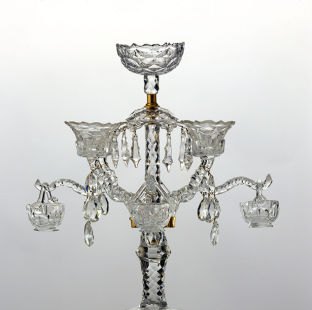
Gorham Epergne and Plateau

Gorham coffee and tea service
Jabez Gorham founded a silver company in Providence, Rhode Island in 1831; his company rose to become the largest silver manufacturer in the world. Over the decades, Gorham created everything from monumental commissioned presentation pieces to functional elegant wares for dining rooms, all the while responding to and shaping each era’s notion of how to celebrate, feast, socialize, honor, and simply enjoy the everyday in style.
In Gorham Silver: Designing Brilliance 1850–1970, Elizabeth Williams casts new light on the legacy of this distinctive company, exploring its significance within industrial, social, aesthetic, manufacturing and marketing contexts. Her talk will chart 120 years of Gorham’s coupling of art and industry as it made the transition from its early handmade wares to its development of a mechanized manufacturing process while putting uniquely American design on the international stage.
Throughout the Gorham Manufacturing Company’s existence, a dual respect for what came before and what was possible for the future was the foundation for its development in and dominance of the silver industry. Gorham’s processes, ranging from administrative management and logistical organization to creative development and manufacturing methods, were recognized as bringing “the inheritance of an older and richer world to the quick and fertile genius of the new … which gives a capital advantage to the American system of business.” Gorham was the epitome of a manufactory – a site where marketable and useful merchandise was produced through human labor and machines.
Elizabeth A. Williams is the David and Peggy Rockefeller Curator of decorative arts and design at the Rhode Island School of Design. She came to RISD after serving as assistant curator of Decorative Arts and Design at the Los Angeles County Museum of Art and the Nelson-Atkins Museum of Art, Kansas City, Missouri. She holds a doctorate in Art History from the Kress Foundation Department of Art History at the University of Kansas, a master’s degree in Art History from the University of Missouri-Kansas City, and a bachelor’s degree in Architectural Studies from the University of Missouri-Columbia.