A Call to Arms: Armorial Ceramics in America
Ron W. Fuchs II, Washington and Lee University
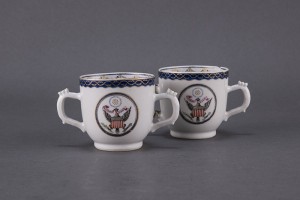
Cups with Great Seal of the United States Made in China, about 1795 Made of Hard-Paste Porcelain Reeves Collection
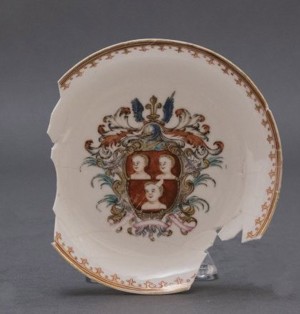
Saucer with the Arms of Fauntleroy Made in China, about 1755 Made of Hard-Paste Porcelain Reeves Collection
Coats of arms were symbols of personal identity and family pride, and an important part of visual culture in 17th-, 18th– and 19th-century America. A Call to Arms: Armorial Ceramics in America will look at the fashion for ceramics decorated with coats of arms and other personalized devices, and set them in their larger cultural context.
As their wealth and ties to a trans-Atlantic economy increased, elite Americans mimicked affectations of the English nobility. Although only a tiny percentage of colonists could legitimately claim the right to display a coat of arms, aspirational Americans incorporated “adopted” coats of arms for adornment of needlework, book plates and silver, as well as their china, all items themselves signifiers of wealth, erudition and sophistication. Elegant china table settings, in a room specifically set aside for dining, on the hosts’ bountiful dining table served to impress one’s guests. Tea tables similarly served as staging for the ritual sharing of exotic beverages, tea, coffee and chocolate. The irony, of course, is that American reliance on coats of arms of the English nobility, and pseudo-armorial devices, was a peculiarly American demonstration of refinement.
The American Revolution together with vastly increased direct trade with China conspired to transform the appearance of armorial porcelains. Simple shields with the initials of a newly married couple supplanted detailed family coats of arms. Military service to one’s country supplanted nobility as an essential element for armorial ceramic services.
Ronald Fuchs earned a bachelor’s degree in history and anthropology from the College of William & Mary. Before graduation, he dug at the St. Mary’s City Archaeological Field School, the site of Maryland’s 17th century capital, and interned at Historic Deerfield’s summer program in early American culture. While he studied at the University of Delaware, he catalogued maritime objects and ceramics at the Independence National Historical Museum, the Independence Seaport Museum and the New-York Historical Society. After his graduation with a master’s degree from the Winterthur program in early American culture, he continued at Winterthur as a curatorial assistant, then assistant curator and associate curator of the Leo and Doris Hodroff collection of porcelains. Exhibits he curated at Winterthur include Made in China: Export Porcelain from the Hodroff Collection at Winterthur; Ancient Egypt and the Egyptian Revival, 1725–1785; “Am I Not a Man and a Brother?”: The Decorative Arts of the Antislavery Movement; and Fairyland Lustre. Mr. Fuchs has served as the Curator of Ceramics and Manager of the Reeves Center at Washington and Lee University since 2008. He wrote Fifty Years, Fifty Objects: Highlights from the Reeves Collection of Ceramics at Washington and Lee (2017) and, with Patricia Halfpenny, Success to America: English Ceramics for the American Market from the Teitelman Collection at Winterthur (2010).
Ron Fuchs contributed “Peace, Plenty, and Independence: Selections from a Collection of English Ceramics made for the American Market” to Antiques and Fine Arts (Autumn/Winter 2006) and “Chinese Export Porcelain from the Doris Hodroff Collection at Winterthur” to the The Magazine Antiques (January 2002). His contributions to Chipstone’s Ceramics in America include “A History of Chinese Export Porcelain in Ten Objects” (2014) and, with other authors, “The most dangerous imitations”: A Group of Spurious Chinese Export Porcelain Decorated with Fame and the American Eagle (2016).
Since 2004, Mr. Fuchs has served as a board member, president and chair of the American Ceramic Circle.
Forum members will receive a Zoom invitation and password via email. Contact 415.363.9969 or info@adafca.com with questions or concerns.